Saturday, January 4, 2014


Wednesday, January 12, 2011
Zebra Teasing Lions
Etosha National Park in northern Namibia is the countries flagship conservation area. It covers some 23000 km2 and is certainly a proper African Game Park, with many high profile game species represented in the park.

After Christmas, we diceded to take my cousin and her family up to Etosha. They were visiting from Cape Town. Her husband had a double-cab Toyota Hilux with which they had traveled up to Namibia. We bundled her two boys and our two boys in the back, and the eight of us headed up to Etosha for two nights.
Despite being in Etosha while it was raining, we saw a lot. We saw a couple Elephant bulls on the northern side of Fisher's Pan. But we were struggling to find lions. I had almost given up when on our last game drive we got lucky and saw some lions at Klein Namutoni. It was the last waterhole we were going to visit before heading out of the park.
View Larger Map
A large male lay about 150 meters away form the waterhole at a clump of bushes. He had a nice full yellow mane, typical of Etosha Lions. Beside him was another female. It could be that these two lions were busy mating, though we didn't see any actually copulation.
At the waterhole itself lay a younger male, without a mane. He was fairly large and we had initially thought it was an adult female. A little further back lay another adult female out in the open.
While we watched a number of herbivores made their way towards the waterhole. As soon as they would see (or smell) the lions, they would stop some distance off.
A few times while we watched, a group of zebras would loose their nerve and bolt off. It appeared that the lions were hungry, and might start hunting in the night. The animals were more weary than usual.
We watched this scene for a while. There were a number of zebra groups now looking on from each of the regular approaches to the waterhole.
Out of the bushes behind the lions a zebra stallion broke out of the bush and walked towards the waterhole. He saw the lions and stopped for a moment. A few more zebras appeared behind him out of the bush.
To our surprise, instead of backing off like all the other zebra had done, this guy started a prompt walk, going right between the lions!
The lazy lions barely looked up. The zebra stallion walked on until he reached a group of zebras.
As he neared the group of mostly mares they trotted up to him and started rubbing against him.
I've seen similar behavior before. In fact almost any time you find lions near a waterhole in Etosha you'll find one or two zebras or other animals approaching them more than all the others. But this one just seemed to take it a bit far. The lions must have been about 100 meters apart, not far for lions, and this zebra had walked right between them. Also the fact that all the other animals approaching the waterhole held well back made it especially strange.
It was so amazing to watch. They were a bit far off, but I had made sure that my camera was ready, I was thinking 'easy meal' as he walked between them, and we all had a laugh at the reaction of the females. It was a bit too human, to Hollywood, the brave hero has all the chicks hanging from him.

[Image by Vernon | License]
After Christmas, we diceded to take my cousin and her family up to Etosha. They were visiting from Cape Town. Her husband had a double-cab Toyota Hilux with which they had traveled up to Namibia. We bundled her two boys and our two boys in the back, and the eight of us headed up to Etosha for two nights.
Despite being in Etosha while it was raining, we saw a lot. We saw a couple Elephant bulls on the northern side of Fisher's Pan. But we were struggling to find lions. I had almost given up when on our last game drive we got lucky and saw some lions at Klein Namutoni. It was the last waterhole we were going to visit before heading out of the park.
View Larger Map
A large male lay about 150 meters away form the waterhole at a clump of bushes. He had a nice full yellow mane, typical of Etosha Lions. Beside him was another female. It could be that these two lions were busy mating, though we didn't see any actually copulation.
At the waterhole itself lay a younger male, without a mane. He was fairly large and we had initially thought it was an adult female. A little further back lay another adult female out in the open.
While we watched a number of herbivores made their way towards the waterhole. As soon as they would see (or smell) the lions, they would stop some distance off.
A few times while we watched, a group of zebras would loose their nerve and bolt off. It appeared that the lions were hungry, and might start hunting in the night. The animals were more weary than usual.
We watched this scene for a while. There were a number of zebra groups now looking on from each of the regular approaches to the waterhole.
Out of the bushes behind the lions a zebra stallion broke out of the bush and walked towards the waterhole. He saw the lions and stopped for a moment. A few more zebras appeared behind him out of the bush.
To our surprise, instead of backing off like all the other zebra had done, this guy started a prompt walk, going right between the lions!
The lazy lions barely looked up. The zebra stallion walked on until he reached a group of zebras.
As he neared the group of mostly mares they trotted up to him and started rubbing against him.
I've seen similar behavior before. In fact almost any time you find lions near a waterhole in Etosha you'll find one or two zebras or other animals approaching them more than all the others. But this one just seemed to take it a bit far. The lions must have been about 100 meters apart, not far for lions, and this zebra had walked right between them. Also the fact that all the other animals approaching the waterhole held well back made it especially strange.
It was so amazing to watch. They were a bit far off, but I had made sure that my camera was ready, I was thinking 'easy meal' as he walked between them, and we all had a laugh at the reaction of the females. It was a bit too human, to Hollywood, the brave hero has all the chicks hanging from him.
Wednesday, November 3, 2010
My Close Encounter With A Hippo
Guest Post by Jade Scully
When I was much younger I spent some time in Zimbabwe with my mother and family. We lived in Harare, but would often go on camping trips to Lake Kariba, or stay on a house boat. These were my favorite times as we were pretty much living in the bush, staying in tents, with no city smog and noise to disturb the peace, and my cousins and I could roam free, playing in the grass, swimming in the rivers and lake – it really makes up one of the best memories I’ve got.
It was on one of these summer holiday trips that my mom and I had a close call with a Hippo.

We would swim in the river every day, while someone stood lookout on the high banks, watching for crocodiles. If there ever was a croc-scare we’d all run straight out of the water, squealing with anxious excitement, to the safety of the ground. Fortunately no-one ever came up close and personal with a smiley croc.
One night, it must have been really late or even early morning, I woke my mother up asking her to take me to the toilet. I really couldn’t keep it in so reluctantly my mom clambered out of the tent, with me close behind her, into the dark night.
I immediately sensed a massive being to my left, and turned towards it. My eyes had not adjusted so all I could see was blackness but insistently I whispered to my mom “there’s a hippo right there”. When I mean “right there” I mean “right there”. We had set up our tent close to another couple’s spot, so there wasn’t too much space between us – maybe a couple paces. But my mother, in her exhausted stupor waved away my frantic insistence and we began making our way to the block of loos. All the while we were walking the hairs on the back of my little neck were on end.
I sighed relief as we reached the toilet building and happily did my business before realizing we’d have to go back. Though, as my mother wasn’t too fazed I relaxed a little and we nonchalantly walked back to our tent, unzipped the entrance and climbed back into the warmth without a worry in the world. Perhaps I had been mistaken.
But I wasn’t. The next morning as we approached the breakfast area we saw the couple who were staying in the tent next to ours. They had bags under their eyes and shocked looks on their faces.
“Did you not hear the Hippo last night!?” they asked us.
My mom hesitated. “No”, she replied, “what do you mean?”
“Last night, there was a hippo grazing right between out tents for hours. We were petrified.”
My mom looked at me in surprise – I really had been right.

It’s a story we’ve told many times over – without even knowing it my mother and I walked past an adult hippo grazing next to our tent without even batting an eyelid! And considering the bad rap they have with some people, we’re lucky he (or she) was in a good mood that night!
Jade Scully is a copywriter, blogger and online marketing enthusiast who has published her work on a series of online publications and websites including Leeulekker who provide a range of travel and touring information for southern Africa travelers.
When I was much younger I spent some time in Zimbabwe with my mother and family. We lived in Harare, but would often go on camping trips to Lake Kariba, or stay on a house boat. These were my favorite times as we were pretty much living in the bush, staying in tents, with no city smog and noise to disturb the peace, and my cousins and I could roam free, playing in the grass, swimming in the rivers and lake – it really makes up one of the best memories I’ve got.
It was on one of these summer holiday trips that my mom and I had a close call with a Hippo.
We would swim in the river every day, while someone stood lookout on the high banks, watching for crocodiles. If there ever was a croc-scare we’d all run straight out of the water, squealing with anxious excitement, to the safety of the ground. Fortunately no-one ever came up close and personal with a smiley croc.
One night, it must have been really late or even early morning, I woke my mother up asking her to take me to the toilet. I really couldn’t keep it in so reluctantly my mom clambered out of the tent, with me close behind her, into the dark night.
I immediately sensed a massive being to my left, and turned towards it. My eyes had not adjusted so all I could see was blackness but insistently I whispered to my mom “there’s a hippo right there”. When I mean “right there” I mean “right there”. We had set up our tent close to another couple’s spot, so there wasn’t too much space between us – maybe a couple paces. But my mother, in her exhausted stupor waved away my frantic insistence and we began making our way to the block of loos. All the while we were walking the hairs on the back of my little neck were on end.
I sighed relief as we reached the toilet building and happily did my business before realizing we’d have to go back. Though, as my mother wasn’t too fazed I relaxed a little and we nonchalantly walked back to our tent, unzipped the entrance and climbed back into the warmth without a worry in the world. Perhaps I had been mistaken.
But I wasn’t. The next morning as we approached the breakfast area we saw the couple who were staying in the tent next to ours. They had bags under their eyes and shocked looks on their faces.
“Did you not hear the Hippo last night!?” they asked us.
My mom hesitated. “No”, she replied, “what do you mean?”
“Last night, there was a hippo grazing right between out tents for hours. We were petrified.”
My mom looked at me in surprise – I really had been right.
It’s a story we’ve told many times over – without even knowing it my mother and I walked past an adult hippo grazing next to our tent without even batting an eyelid! And considering the bad rap they have with some people, we’re lucky he (or she) was in a good mood that night!
Thursday, October 14, 2010
Water In Africa
On the 15th of October bloggers from around the world will be posting for Blog Action Day
This year the theme is water, which having lived on deserts for so many years is close to my heart.
I'll be blogging over at my personal blog, Sandcurves.com on the topic on Sunday.
Africa is the world's second driest continent, and one of the largest water systems, the Congo drainage, occurs where there are relatively few people. Droughts are as much what one envisages when you think of 'Africa' as Lions and sunset cocktails.
Blog Action Day 2010: Water from Blog Action Day on Vimeo.
Are you taking part - water is one of the worlds massive problems, but there is so much that can be done, and a lot of it starts with raising an awareness of water - do your bit, register your blog and take part.
This year the theme is water, which having lived on deserts for so many years is close to my heart.
I'll be blogging over at my personal blog, Sandcurves.com on the topic on Sunday.
Africa is the world's second driest continent, and one of the largest water systems, the Congo drainage, occurs where there are relatively few people. Droughts are as much what one envisages when you think of 'Africa' as Lions and sunset cocktails.
Blog Action Day 2010: Water from Blog Action Day on Vimeo.
Are you taking part - water is one of the worlds massive problems, but there is so much that can be done, and a lot of it starts with raising an awareness of water - do your bit, register your blog and take part.
Thursday, September 9, 2010
Support the WWF Rhino Campaign
I remember well my first close up encounter with rhino. It was in Meru National Park in Kenya. I can't remember exactly what year it was - early 1980s. The park then was a rather wild place and we enjoyed visiting it. It was on our way up north to where we lived.

Meru had a bunch of white rhino that had been re-introduced and they were watched 24/7 by guards. At the time visitors were allowed to go out for a walk with the guards and the rhino. As big an event as it was, I can't actually remember the details. I'm not sure if we actually walked with them or just spent a little time with the? Whatever, I have a clear picture in my mind of that day, a bunch of guards with their rifles, and the white rhino.
We went back to school and carried on. But later on we heard that the rhino had been shot. The poachers had Ak-47s and RPG-7s. The guards with their bolt-action rifles didn't stand a chance. RPGs were so easy to come by from Somalia that guys were buying them in exchange for food when there were droughts in southern Somalia. Some Rhino were actually shot with RPGs - AK-47s just aren't hunting rifles.
Some of you may remember better than me, but I believe that at that time, that incident was the end of White Rhino in Kenya. I certainly didn't see any more of them.
That, at the age of about 10 was my introduction to the story of rhino, and for a little kid to have actually seen rhino that were shot in such a gruesome way, it was something that would stay with me.
Since then the conservation effort for Rhinos have come a long way and has had so much press that it has become a little boring. I honestly seldom read the "Save the Rhino" articles anymore - same old same old.
But, of course, to the rhinos the story isn't so boring. Rhino poaching hasn't gone away. It hasn't even changed that much. There is a very real battle still going on. Some may argue that Rhino are in a natural dying stage of their evolution cycle? I can't comment on that. But if we simply let Rhino die, what about whales, what about turtles. I know, you have heard this so often, but we really are at a point where we can do something concrete about these things.
Interested in doing your bit? Visit the WWF South Africa Rhino Campaign web page and learn a little more about what you can do towards saving Rhino. WWF is going to have a Save the Rhino day on the 22nd of September, and asking everyone to:
On 22 September, RHINO DAY, WWF calls on all concerned citizens of the world to dust off their vuvuzelas, toot their horns and to make as much noise as possible, at 1pm, as a symbolic act to send a powerful message to leaders that the time to take serious and effective action against rhino poaching is now.
You can also join the Help our Rhino (HORN) cause.
In May I was in Etosha and spent a night at Okaukuejo. At the waterhole we had one white rhino and we all lost count of the black rhino that came to drink. It was special, though that is still common at Okaukuejo.
I had the chance as a student at Addo Elephant National park to see a little of the effort first hand, where Black Rhino from zoos were being re-introduced to the wild. It all takes money and money that is all wasted if someone just goes and shoots them.

Sunday, June 6, 2010
Guest post - Battle to the Death
Friends of mine sent me this amazing story. Copyright for the images and story remain with the author, James Crookes.
Note, the story and images are a little violent!
One of the joys of living in the bush is that the most amazing sightings tend to
happen at the most unexpected times and often in the most unexpected places.
On the way back from breakfast, walking through the staff village, I noticed two
birds rolling around on the ground outside one of the rangers’ rooms. They were
obviously having some sort of altercation, so, with a sense of amusement, I
decided to stop and watch them for what I expected to be a couple of seconds of
interaction before going their separate ways. What unfolded was much more
serious than I could ever have expected and it turned out that the birds were
engaged in mortal combat. What developed turned out to be the most gruesome
scene I have witnessed in my time in the bush and, my sense of amusement
quickly changed to one of astonishment.
As I moved closer I noticed that the birds were both bearded scrub-robins
(Cercotrichas quadrivirgata), which are monogamous and are known to be
territorial throughout the year. By definition, a territory will be defended against
members of the same species, with the extent of the territoriality depending on
factors such as the availability of food, population densities and habitat.
Although there is no sexual dimorphism in this species, based on their behaviour,
I concluded that this was a territorial battle between two males. I expected that
at worst, the territorial male would have engaged the other male, shown him
who is boss in the area being defended, and left him to lick his wounds in
someone else’s territory. After all, these territorial disputes put both parties at
risk as the aggressor also faces a risk of being injured during the course of the
altercation, so it is in both parties’ interest to settle the dispute with as little
physical interaction as possible. The dominant bearded scrub-robin in this
territory, however, obviously had a different idea.

I’m not sure how long the fight had been going on for when I arrived, but at that
stage, although one of the birds was clearly dominating, both were putting up a
fight and, amidst a lot of wing flapping, they were rolling around on the floor.
Both seemed to be trying to peck each other, but one of the birds had a good
grip on the other’s leg, so was able to dominate him. As time went by, I noticed
that the dominant scrub-robin was making a distinct effort to peck the other,
which by this stage almost seemed submissive, on his nape and the back of his
head. This continued for a couple of minutes, after which the other bird, clearly
having sustained some injuries, was completely submissive. My expectation was
that the dominant scrub-robin, clearly the victor, would now have left the scene
and carried on with his daily foraging. This, however, was not to be.


of us, the dominant male continued to peck at the other bird’s head and, after a
while, had pecked out the eyes and plucked off the majority of the feathers. This
took the scene to a new level and it was now obvious that the dominant male
wouldn’t stop until the other bird was dead. At this stage there was the odd
whispered suggestion that we chase the scrub-robin away to give the other a
chance of survival, however one needs to bear in mind that we are in nature and
that this is a manifestation of the idea of the survival of the fittest. We are in a
world where there is more than enough human interference and although this
may appear cruel and gory, it likely happens all around us without us even
knowing. Being able to view this sort of interaction is a privilege and enables us
to gain an invaluable insight into the behavior of these animals. Although
sometimes tempting and I must admit, it was a thought that went through my
head early on in this battle, it is best not to interfere and let nature take its
course.

that the targeted bird was on death’s doorstep, but miraculously, every couple of
minutes he would writhe, bringing about more aggression from his attacker. His
scalp was exposed and bleeding and the attacker continued to pluck flesh from
his head. The level of aggression was so pronounced that the attacker appeared
to have blood splatter on his otherwise clean belly and chest.


Note, the story and images are a little violent!
Battle to the Death
James Crookes [his blog]One of the joys of living in the bush is that the most amazing sightings tend to
happen at the most unexpected times and often in the most unexpected places.
On the way back from breakfast, walking through the staff village, I noticed two
birds rolling around on the ground outside one of the rangers’ rooms. They were
obviously having some sort of altercation, so, with a sense of amusement, I
decided to stop and watch them for what I expected to be a couple of seconds of
interaction before going their separate ways. What unfolded was much more
serious than I could ever have expected and it turned out that the birds were
engaged in mortal combat. What developed turned out to be the most gruesome
scene I have witnessed in my time in the bush and, my sense of amusement
quickly changed to one of astonishment.
As I moved closer I noticed that the birds were both bearded scrub-robins
(Cercotrichas quadrivirgata), which are monogamous and are known to be
territorial throughout the year. By definition, a territory will be defended against
members of the same species, with the extent of the territoriality depending on
factors such as the availability of food, population densities and habitat.
Although there is no sexual dimorphism in this species, based on their behaviour,
I concluded that this was a territorial battle between two males. I expected that
at worst, the territorial male would have engaged the other male, shown him
who is boss in the area being defended, and left him to lick his wounds in
someone else’s territory. After all, these territorial disputes put both parties at
risk as the aggressor also faces a risk of being injured during the course of the
altercation, so it is in both parties’ interest to settle the dispute with as little
physical interaction as possible. The dominant bearded scrub-robin in this
territory, however, obviously had a different idea.

Early on in the battle, one bird clearly dominating the other
I’m not sure how long the fight had been going on for when I arrived, but at that
stage, although one of the birds was clearly dominating, both were putting up a
fight and, amidst a lot of wing flapping, they were rolling around on the floor.
Both seemed to be trying to peck each other, but one of the birds had a good
grip on the other’s leg, so was able to dominate him. As time went by, I noticed
that the dominant scrub-robin was making a distinct effort to peck the other,
which by this stage almost seemed submissive, on his nape and the back of his
head. This continued for a couple of minutes, after which the other bird, clearly
having sustained some injuries, was completely submissive. My expectation was
that the dominant scrub-robin, clearly the victor, would now have left the scene
and carried on with his daily foraging. This, however, was not to be.


The birds engaged in battle, fighting for survival
By now a reasonable crowd had gathered, all with the same sense of
astonishment, to witness this epic battle. Some suggested that one of the scrub-
robins had obviously come home that morning to find the other in bed with his
partner and was now teaching him a lesson. This anthropomorphic idea seems to
be the only logical explanation for what was taking place. Just as we were
discussing this, we noticed a third bearded scrub-robin enter the fray. Our
assumption was that this was the ‘offending’ female, as she stayed on the
outskirts and watched for a couple of minutes, before hopping off to carry on
with her daily activities.
All this time, without paying any attention to either the third scrub-robin or anyastonishment, to witness this epic battle. Some suggested that one of the scrub-
robins had obviously come home that morning to find the other in bed with his
partner and was now teaching him a lesson. This anthropomorphic idea seems to
be the only logical explanation for what was taking place. Just as we were
discussing this, we noticed a third bearded scrub-robin enter the fray. Our
assumption was that this was the ‘offending’ female, as she stayed on the
outskirts and watched for a couple of minutes, before hopping off to carry on
with her daily activities.
of us, the dominant male continued to peck at the other bird’s head and, after a
while, had pecked out the eyes and plucked off the majority of the feathers. This
took the scene to a new level and it was now obvious that the dominant male
wouldn’t stop until the other bird was dead. At this stage there was the odd
whispered suggestion that we chase the scrub-robin away to give the other a
chance of survival, however one needs to bear in mind that we are in nature and
that this is a manifestation of the idea of the survival of the fittest. We are in a
world where there is more than enough human interference and although this
may appear cruel and gory, it likely happens all around us without us even
knowing. Being able to view this sort of interaction is a privilege and enables us
to gain an invaluable insight into the behavior of these animals. Although
sometimes tempting and I must admit, it was a thought that went through my
head early on in this battle, it is best not to interfere and let nature take its
course.

The aggressor with a good grip from which to continue his attack, having plucked most of the head feathers.
After about 45 minutes the battle continued and by this stage we were convinced
that the targeted bird was on death’s doorstep, but miraculously, every couple of
minutes he would writhe, bringing about more aggression from his attacker. His
scalp was exposed and bleeding and the attacker continued to pluck flesh from
his head. The level of aggression was so pronounced that the attacker appeared
to have blood splatter on his otherwise clean belly and chest.
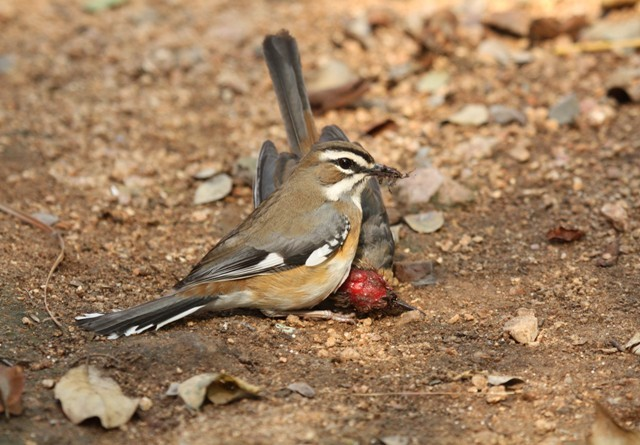
The head and scalp had clearly taken a beating to expose this gory scene.

The Bearded scrub-robin’s chest, showing evidence of blood splatter after the gruesome battle
Amazingly, the victor continued to peck away at the deceased’s head for a
couple of minutes, even though it was clearly dead. Eventually he decided he
had achieved his goal. He lifted his head, had a look around, and hopped off as
though nothing much had happened, carrying on with his foraging in the leaf
litter surrounding the scene of the battle.

This interaction caused me to look at the bearded scrub-robin with new eyes.
What had always been, to me, a pretty bird, with a cheerful whistling call, has
exposed a different side to its nature, one that rivals the most aggressive and
savage I have seen in any animal of the African bushveld.
James Crookes
Trainee Guide
Singita Game Reserve
Finally, in a dramatic scene after a valiant defense, the injured bird extended its
wings, raised its tail and took its last breath. This epic battle had lasted just over
an hour.
wings, raised its tail and took its last breath. This epic battle had lasted just over
an hour.
Amazingly, the victor continued to peck away at the deceased’s head for a
couple of minutes, even though it was clearly dead. Eventually he decided he
had achieved his goal. He lifted his head, had a look around, and hopped off as
though nothing much had happened, carrying on with his foraging in the leaf
litter surrounding the scene of the battle.

The end result of the attack. After a valiant effort, the loser finally took his last breath
This interaction caused me to look at the bearded scrub-robin with new eyes.
What had always been, to me, a pretty bird, with a cheerful whistling call, has
exposed a different side to its nature, one that rivals the most aggressive and
savage I have seen in any animal of the African bushveld.
James Crookes
Trainee Guide
Singita Game Reserve
Saturday, September 26, 2009
Lioness Teaches her Cubs to Hunt

Guest post by Jason Whitehead.
Shortly after daybreak I got a call from a fellow guide on the radio to say that he had spotted a lioness on the move with her three sub adult cubs not far from where I was enjoying the view of a White Rhino. White Rhinos are incredible animals and I could sit an watch them for days, but they are a fairly common sight on the title="Welgevonden Private Game Reserve">Welgevonden Private Game Reserve situated in the northern province of South Africa. With a quick chat to my guests, we agreed to go and see of we could find her.
Welgevonden has a policy that no vehicles are permitted off road, this is to protect the environment and the many small creatures that you could easily crush by taking your 4x4 through the middle of the bush. I think this is excellent, but sometimes it can be a little frustrating when you know where an animal is but cant get to it. Today however was to be our lucky day, we did manage to find her and her cubs, but they were moving very quickly away from us through the bush which meant that the sighting would not last long. I decided to head out and wait at a road that she was heading towards about 5 minutes drive away. When we got there, there was a small herd of Zebra and Wildebeest grazing on the plain behind us, but right in the path of where I expected the lioness to to come out.
Sure enough a few minutes later, through my binoculars I spotted her in the tree line at the edge of the open plain. She too had spotted the herbivores and by her posture was obviously hungry. So in front of us we had the lioness hidden in the trees and an open area of around 100 meters to the road which we were on and then behind us about another 50 meters to the Zebra and Wildebeest. It was winter and so she did not have that much cover, so with my guests we watched her still within the trees move round to get our Land Rover right in between her and her potential prey. Then crouched very low she very slowly headed straight towards our vehicle, with her cubs hidden directly behind her in single file. If it wasn't for the fact that I knew that she was interested in what was behind us, this could have been rather frightening as it would have looked like she was hunting us! Even so we still had to be careful as a lion in hunting mode should not be taken lightly, and made sure my guest did not offer an easier alternative to a much more powerful and fast running Zebra.
Sure enough after about half an hour they got to our vehicle and then slowly moved around it, it was a fantastic sight to see such wonderful animals so close up. Now that they were behind us she and her cubs only had the tall grass as cover, but were now only 50 meters from their quarry. Then something very interesting happened, she stopped moving and her 3 cubs came around in-front of her and continued to stalk towards their prey whilst she just lay there watching. When the three cubs got to within 40 meters of the completely oblivious herd of Zebra and Wildebeest, one of them broke cover and just got up and ran towards them. With no chance of catching the herd, the cub had totally spoilt a mornings work for the rest of the family. When it had finished half heatedly running after the somewhat alarmed but now safe herbivores, they returned to their mother, who when gave the cub who had transgressed a snarl and then a tremendous slap right across it's face.
Right beside us, we witnessed some incredible animal behavior and a lesson that I think that cub would never forget. It had been an excellent morning in the bush.
About the Author
Jason Whitehead was born and grew up in Zimbabwe. Passionate about wildlife, travel and a keen wildlife and bird photographer, he is a qualified Field Guide (safari guide) and has worked on safari lodges in South Africa. He owns and runs the Safari Holiday Guide and the Best Binoculars & Binocular Reviews websites that now keep him behind a desk most of the time, but is always looking for an excuse to get back into the bush.
Would you like to post a story on this blog. Please feel free to contact me at frantic.naturalist [you know what comes here, skipped for spam] gmail.com
Tuesday, September 22, 2009
Rain to you, Rain to me
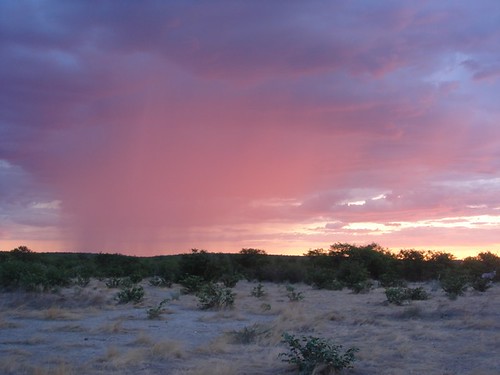
This post is simply a little chat about the weather. I got up at 3h00 this morning, partly due to chronic insomnia and but mainly due to the wonderful sound of thunder in the distance.
What do people say about rain? There are lots of feelings. An easy way to see is to have a look at Twitter:
@Plunker219 says "rain rain go away, now?"
@allyrok05 says "@charwalt im sick and tired of the rain...im outside all day at work so i need nice weather. "
@the_coffeegirl says "Really tired of the rain. But I haven't floated away yet."
But there are some voices from the opposition:
@chrisevans17 says "Awesome, it's gonna rain. That's different."
and me...
@Namibnat: We had thunder over Windhoek this morning...I really hope it's going to rain. There is a great smell of rain in the air.
Namibia is a dry country. I grew up in northern Kenya, which is also really dry. Even in the areas in southern and eastern Africa where there is a little more rain, usually there are long, long dry spells without any rain.
When you go for a long time without any rain, the most enjoyable, exiting rain is the rain that breaks the dry season. Those first few short but dramatic thunder storms we get...about now.
It's still early days, and October is still considered a dry month, so I shouldn't get my hopes up to much.
When you have so little of something it conjours up memories, and rain is a good one for that.
An early memory of rain for me is from Camaroon. My parents were there to do Africa orientation for an organization they worked for. One thing they had to do was a survival night. Most people had to do it alone, but if they had kids they would take one child along. I went with my dad. We went into the jungle as a group and had to hack our way in. The leaders told each group where to stop and make their camp for the night. You had a few provisions and had to make a bed. I can't really remember much of it (I was 8) but I do remember that it rained non stop. We tried to make a fire...the wood is drenched, the whole place is just constantly wet.
We moved to Kenya and moved to a place called Korr. It's in the heart of the Kaisuit Desert, a rather small arid region between Marsabet and the bottom of Lake Turkana in Kenya's north. It didn't rain much at all. We went through the 1984 drought, which changed our lives forever, people were starving and the Kenyan government was saying that the problem was contained in Ethiopia to stop it from having any negative impact on tourism, Kenya's cash cow.
The people we lived with are the Rendile, and Rendile people love the rain in a way that I couldn't hope to explain. The memories of the rains that break the long dry season in Kenya are amazing. Rendile dance in a very similar way to the Masai. With braking rain, the dancing goes on all night. Wonderful. I can remember the rain on the tin roof of our house as I would go to sleep with the distant singing of the Rendiles.
When it would rain there would be lots of dry river beds that can turn into torrents of flowing water. They would come down in flash floods. It was amazing, and could at times be dangerous.
We would also get Velvet Mites coming out after the rain. I don't know why, but the Rendille kids would run around and draw circles around them.
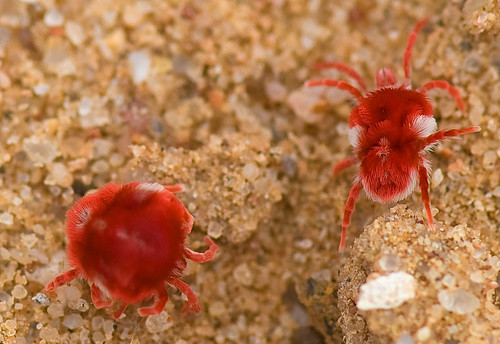
This Picture shows a Velvet Mite,
similar to the ones we would find as kids
Photo by Paul Garland on Flickr (licence)
similar to the ones we would find as kids
Photo by Paul Garland on Flickr (licence)
Even now, after rain, we find them in the Namib.
Once we had driven to a nearby town. The roads were basically just two tracks. While we were there, there had been a downpour and we ended up getting stuck in the mud and sleeping there the night. When we woke up the next morning there was a pack of wild dogs around the car. It was such a special family experience.
Last year, on the first of April (ironic) I had a guests at Sossusvlei Desert Lodge and took them to Sossusvlei in the morning. It rained the whole time. A massive downpour. If you go to Sossusvlei today, much of the green on the dunes is from that single day's rain.
In the afternoon, we were watching the weather, and when it looked like it would clear, we jumped in the game drive vehicle and headed out. As we started, the rain started belting down. We did about three kilometers before calling it quits. On our way back it just kept pouring. The rain meter showed that 19mm had fallen in those few minutes. The roads had turned to rivers, and I could hardly drive, it was hitting my face so hard. It was amazing.
Rain in the drier parts of Africa usually comes in thunderstorms and usually comes down hard. The rain usually breaks the heat of summer, so the short period of being cold is a welcome relief.
At Sossusvlei Desert Lodge, where I worked for many years, when these early rains would come often the staff would simply stop work, get together and sing, just out of happyness. It always helped prevent any guests from complain that they just left Europe to come to Africa and get away from the rain. African Desert thunderstorms are amazing wonderful things to experience.
Wednesday, May 13, 2009
There's not nothing there
When you spend some time viewing wildlife, the natural tenancy is to get blaze about the normal animals quickly. As tour guides we often feel under pressure to 'produce' the wild and wonderful...elephants, lions, leopards and so on. And often guests on their first ever Safari will get bored of Springbok after having only had a couple sightings. Its normal...it's human nature.
When you are new in an area, you would like to keep seeing new and more exciting things. Time is a problem...with only three or four days in a national park like Etosha, you are hardly going to see everything there and sometimes there can be a bit of pressure to try to do so.
But for me some of my favorite times in the bush have been times when we took our attention away from the 'big five' rush, and watched the things that we normally don't. So often in Etosha you go into an area, meet a guide coming out, and ask him "is there anything there?" The typical answer, "No, there's nothing there."
Well, there is never nothing. Sometimes what is there may just be the trees and some flies, but very rarely is there 'nothing'.
One such experience always stood out to me, almost as a lesson. We were in the west of Etosha. It was rainy season, but was dry at the time. There were very view animals at waterholes. But the guests had all had Safari experiences before, and were happy to slow down and watch a little.
We went into one waterhole, and at first it appeared that there was nothing. We started to watch the birds coming down to drink, and noticed that they would fly up in a whole flock from time to time. We soon started to realize that each time the birds, mostly Red-billed Queleas Quelea quelea and a mix of doves, would sit, terrapins would start moving towards the birds.
It was getting towards the heat of the day, and the birds where starting to get flustered by this continual assault from the terrapins. Eventually we noticed that from time to time the terrapins actually managed to catch a bird, which they would rip up quickly. Amazing.
We carried on watching. Some Jackals joined the action. They literally just jogged around the outside of the waterhole. It really looked like they were not even trying. But in the confusion, as we watched the Jackals also started to manage to catch a few doves.
Then a pair of Red-necked Falcons Falco chicquera joined the action, as did a single Gabar Goshawk Melierax gabar. While we watched each of these birds also managed to catch a couple Red-billed Queleas.
It was an amazing experience, and has stayed with me for years. What was so amazing was that while we watched this whole bunch of excitement going on, a number of cars came by the waterhole and just looked and drove on, probably saying "Just a couple Jackals" or even more likely, "There's nothing there."
When you are new in an area, you would like to keep seeing new and more exciting things. Time is a problem...with only three or four days in a national park like Etosha, you are hardly going to see everything there and sometimes there can be a bit of pressure to try to do so.
But for me some of my favorite times in the bush have been times when we took our attention away from the 'big five' rush, and watched the things that we normally don't. So often in Etosha you go into an area, meet a guide coming out, and ask him "is there anything there?" The typical answer, "No, there's nothing there."
Well, there is never nothing. Sometimes what is there may just be the trees and some flies, but very rarely is there 'nothing'.
One such experience always stood out to me, almost as a lesson. We were in the west of Etosha. It was rainy season, but was dry at the time. There were very view animals at waterholes. But the guests had all had Safari experiences before, and were happy to slow down and watch a little.
We went into one waterhole, and at first it appeared that there was nothing. We started to watch the birds coming down to drink, and noticed that they would fly up in a whole flock from time to time. We soon started to realize that each time the birds, mostly Red-billed Queleas Quelea quelea and a mix of doves, would sit, terrapins would start moving towards the birds.
It was getting towards the heat of the day, and the birds where starting to get flustered by this continual assault from the terrapins. Eventually we noticed that from time to time the terrapins actually managed to catch a bird, which they would rip up quickly. Amazing.
We carried on watching. Some Jackals joined the action. They literally just jogged around the outside of the waterhole. It really looked like they were not even trying. But in the confusion, as we watched the Jackals also started to manage to catch a few doves.
Then a pair of Red-necked Falcons Falco chicquera joined the action, as did a single Gabar Goshawk Melierax gabar. While we watched each of these birds also managed to catch a couple Red-billed Queleas.
It was an amazing experience, and has stayed with me for years. What was so amazing was that while we watched this whole bunch of excitement going on, a number of cars came by the waterhole and just looked and drove on, probably saying "Just a couple Jackals" or even more likely, "There's nothing there."
Nature works at nature's pace. There is always something going on. It's just a matter of tuning in to the pace of nature, and a matter of choosing what we are going to enjoy.
Monday, March 9, 2009
Spitting Black Spitting Cobras
Two short stories about Black Spitting Cobras spitting.
Situations like this are really rare. Much more often one encounters the small benign snakes, and even when you encounter cobras, things usually don't go wrong. It's usually hard to even get a decent look as these snakes do their best just to disappear. In all cases of being spat at, the victim was handling the snake.
Many people fear snakes a lot, but if you learn to appreciate them, respect them, then they soon become fascinating.
- Don't drink and catch cobras One of our guides was called to my house when I was away on holiday at the time that I worked at Sossusvlei Mountain Lodge. Each night our power would be off, and we shared our satellite TV with the Chef next door. His girlfriend had gone into our house to turn on the power to the TV reception, and met a Black Spitting Cobra.
The ranger had already had a beer in the afternoon, as he had the afternoon off with no guests. As he was the only one around who would catch the snake, he was called. After all, he had only had a couple drinks?? Anyway, the snake was caught, but he got spat on.
He didn't think much of it, and took the snake out to release it. Later he broke out in an amazing rash. I got back soon afterwards from my leave and we phoned a doctor who was interested in snake bites. He was amazed, even excited at the reaction. It's a rather rare snake, and lives in areas where there are few humans, and it has a rather unsual venom. In the end, it eventually just cleared up. But it taught the ranger a couple lessons! - Careful who you look in the eye One of the nature conservationists on our reserve also had a run in with a Cobra. I was working in Windhoek that year (2003.) One day I saw him in Windhoek. He told me that he had been in hospital because he had been spat in the eye by a Black Spitting Cobra. He had seen a small snake in the grass by his house, and it went under a little ledge. He didn't recognize it, as we don't often see the younger forms of these snakes.
He got his snake stick and looked under the ledge of the house. There are many small constrictors in the area that are harmless. We don't often see the more venomous snakes. So he didn't expect it. But as he bent down the snake spat him straight in the eye.
He knew right away that it was bad. He ran the hosepipe on the small lawn they have, and just poured water over his eyes. He was flown out to hospital and had a painful couple days, but recovered fully.
Situations like this are really rare. Much more often one encounters the small benign snakes, and even when you encounter cobras, things usually don't go wrong. It's usually hard to even get a decent look as these snakes do their best just to disappear. In all cases of being spat at, the victim was handling the snake.
Many people fear snakes a lot, but if you learn to appreciate them, respect them, then they soon become fascinating.
Tuesday, March 3, 2009
New Managment - and Cobras
During my time at Sossusvlei Desert Lodge (it was called Sossusvlei Mountain Lodge at the time) I saw a number of changes in management. It was always an eventful time. Staff take time to adjust to the new management style, the new manager takes time to adjust to the lodge, to the staff and so on. It's just normal. It's like that in any normal organization.
A few years back one management change was a little more eventful than the others. There were lots of members of management around at the time. I was mainly guiding and not involved much with management (except for managing the guiding department.)
My typical day at Sossusvlei Desert Lodge as a guide involved a very early start, a long break in the middle of the day, and then working until the guests went to dinner.
During this particular management changeover I was off for my lunch break. I lived some three kilometers from the lodge at the staff village. I got a phone call from the manager to be. There was a Black Spitting Cobra Naja nigricollis woodi at the lodge. They couldn't find the snake stick. Could I come and help.
I found the snake stick without to much trouble. The snake had gone past all the people having lunch outside, up the wall, onto the roof. The roof was a depression (you can see the exact area where the snake was in this picture from Expert Africa's Website.
I had to climb up the side wall and was assisted by one of the managers from Windhoek up on the roof. I think I was the only one, aside from one of the assistant managers, who had caught cobras before. So I did all the actual catching of the snake. It got itself really wound up tight in a corner, having gone through a hole out of the roof, and down a narrow area where wires ran down the side of the building.
It was hard to pull it out. It kept it's head inside of it's coils, so that I could only pull out it's body. That's not ideal, because when you pull the body away it's head can strike at you. Eventually we got it out okay. It had a little spit at me, but very little got on me. I passed the snake into the container below, where the assistant manager controlled it and put the lid on. We drove it out and let it go.
Cobras were rather rare for us, and this day was really something else, with the cobra really putting on a show for all our visitors for the changeover, and a dramatic start to our new manager's time at the lodge.
A few years back one management change was a little more eventful than the others. There were lots of members of management around at the time. I was mainly guiding and not involved much with management (except for managing the guiding department.)
My typical day at Sossusvlei Desert Lodge as a guide involved a very early start, a long break in the middle of the day, and then working until the guests went to dinner.
During this particular management changeover I was off for my lunch break. I lived some three kilometers from the lodge at the staff village. I got a phone call from the manager to be. There was a Black Spitting Cobra Naja nigricollis woodi at the lodge. They couldn't find the snake stick. Could I come and help.
I found the snake stick without to much trouble. The snake had gone past all the people having lunch outside, up the wall, onto the roof. The roof was a depression (you can see the exact area where the snake was in this picture from Expert Africa's Website.

I had to climb up the side wall and was assisted by one of the managers from Windhoek up on the roof. I think I was the only one, aside from one of the assistant managers, who had caught cobras before. So I did all the actual catching of the snake. It got itself really wound up tight in a corner, having gone through a hole out of the roof, and down a narrow area where wires ran down the side of the building.
It was hard to pull it out. It kept it's head inside of it's coils, so that I could only pull out it's body. That's not ideal, because when you pull the body away it's head can strike at you. Eventually we got it out okay. It had a little spit at me, but very little got on me. I passed the snake into the container below, where the assistant manager controlled it and put the lid on. We drove it out and let it go.
Cobras were rather rare for us, and this day was really something else, with the cobra really putting on a show for all our visitors for the changeover, and a dramatic start to our new manager's time at the lodge.
Tuesday, February 24, 2009
How not to catch a Black Spitting Cobra
I am going to do a series of posts about a wonderful snake called the Black Spitting Cobra Naja nigricollis woodi. It's a snake we got to know on NamibRand Nature Reserve and it sort of seemed to get itself in trouble.
Black Spitting Cobras are a fairly rare variety of Cobra. They are a sub-species of a larger group. I am not sure how the taxonomy of the whole group will break down eventually. I think there may be some changes. For us, however, it was our main Spitting Cobra.
I have grown up with snakes and snake related issues. We had numerous snake related medical trips when I was young, and after I learned to drive, and my parents put me on the medical trips, I had some serious snake victims to deal with by myself. So I am certainly not ignorant of the dangers of snakes. I have seen some serious damage done by Puff Adders Bitis arietans. I'm sure you've seen the pics. I'm not going to go into detail.
But through it all you start to learn about snakes. Through familiarity comes a sense of admiration. I am a bit of a softy, preferring to handle small snakes with no venom. I have never had to handle something as vicious as a Black Mamba Dendroaspis polylepis or as big as an African Rock Python Python sebae. But these spitting cobras came in without us looking for them (at least, not at such close quarters.) So I had to learn, and that is what these posts are all about.
At Sossusvlei Mountain Lodge (now Sossusvlei Desert Lodge) we did start to occasionally get Black Spitting Cobras through the area. What would we do...simple...we would catch and release them. How nice. So simple!
In the early years we managed to get the couple that run the Living Deserts snake park in Swakopmund to come out and do a reptile educational for us at the lodge. They were such nice, easy going people and really went out of their way to cater to us. They brought a few snakes along, including a Snouted Cobra Naja annulifera, I think (It's some time back now.)
While they were there, we discussed the best way to go about the educational experience. They decided that they could spend all day with the guides, but they also suggested spending some time with any staff who may encounter snakes. Almost everyone showed up for the sessions they gave for the general staff. It was fantastic. They showed us how to catch snakes in a safe way. The main technique for those who hadn't handled snakes before, involved turning large containers upside down and and using long things like brooms to encourage the snake to go under the container. Then to slide something under it, trapping the snake in the container.
Great theories sometimes work. They do. Perhaps most of the time. But now, what if the ground isn't so flat? The snake gets out while you try to push the flat thing under the container. It doesn't take a lot of imagination to figure out that their can be some challenges. But those of us who had now acquired this knowledge were not thinking about that.
The opportunity didn't take long to arrive. One of the guides was sitting at his desk reading the one day, when he saw a snake come into the room with him. He tried to see where it would go, but soon it went behind a fridge in the kitchen area of the guides house. It was a small area, and wisely he decided to move out and call for some help.
Now the trouble wasn't that nobody wanted to catch the snake. The trouble, after the educational, with a snake that get's handled regularly, and on flat ground, was that everyone thought they were an expert and we had a couple dozen people show up (including me, of course) to catch the snake.
I'll start by saying that nobody got hurt. The snake may have got hurt, certainly disturbed by it all. But it lived to do, well whatever snakes do, another day. Most people in Africa would simply just kill it.
So, the snake was behind the fridge. Brave though everyone was, this small space that it had got itelf in was a problem. Nobody wanted to be in that little space with it.
So, someone switched off the fridge, and using the cable, we pulled the fridge to the door. We managed to pull it around, so that we could see that the snake was now wound up in the inside of the workings of the fridge. And nobody was going to stick their hands in there to get it out.
We had no tools other than broom sticks and the like. So eventually we yanked the whole fridge out. It fell on it's side and the stressed Cobra started to run around. It was a mad bustle of various 'want to be' experts running around trying to catch the snake.
The snake remained really calm in the beginning, but eventually, after going under the big container for the fifth or so time, it had had enough, and started to spit at us.
It seemed, however, to give up on the aggression just as quick, and almost seemed to decide to go in the container for us, just to get it over with. So we caught it, took it far away, and released it again. When we turned over the container, it just slid away. We all know what it was thinking...
Black Spitting Cobras are a fairly rare variety of Cobra. They are a sub-species of a larger group. I am not sure how the taxonomy of the whole group will break down eventually. I think there may be some changes. For us, however, it was our main Spitting Cobra.
I have grown up with snakes and snake related issues. We had numerous snake related medical trips when I was young, and after I learned to drive, and my parents put me on the medical trips, I had some serious snake victims to deal with by myself. So I am certainly not ignorant of the dangers of snakes. I have seen some serious damage done by Puff Adders Bitis arietans. I'm sure you've seen the pics. I'm not going to go into detail.
But through it all you start to learn about snakes. Through familiarity comes a sense of admiration. I am a bit of a softy, preferring to handle small snakes with no venom. I have never had to handle something as vicious as a Black Mamba Dendroaspis polylepis or as big as an African Rock Python Python sebae. But these spitting cobras came in without us looking for them (at least, not at such close quarters.) So I had to learn, and that is what these posts are all about.
At Sossusvlei Mountain Lodge (now Sossusvlei Desert Lodge) we did start to occasionally get Black Spitting Cobras through the area. What would we do...simple...we would catch and release them. How nice. So simple!
In the early years we managed to get the couple that run the Living Deserts snake park in Swakopmund to come out and do a reptile educational for us at the lodge. They were such nice, easy going people and really went out of their way to cater to us. They brought a few snakes along, including a Snouted Cobra Naja annulifera, I think (It's some time back now.)
While they were there, we discussed the best way to go about the educational experience. They decided that they could spend all day with the guides, but they also suggested spending some time with any staff who may encounter snakes. Almost everyone showed up for the sessions they gave for the general staff. It was fantastic. They showed us how to catch snakes in a safe way. The main technique for those who hadn't handled snakes before, involved turning large containers upside down and and using long things like brooms to encourage the snake to go under the container. Then to slide something under it, trapping the snake in the container.
Great theories sometimes work. They do. Perhaps most of the time. But now, what if the ground isn't so flat? The snake gets out while you try to push the flat thing under the container. It doesn't take a lot of imagination to figure out that their can be some challenges. But those of us who had now acquired this knowledge were not thinking about that.
The opportunity didn't take long to arrive. One of the guides was sitting at his desk reading the one day, when he saw a snake come into the room with him. He tried to see where it would go, but soon it went behind a fridge in the kitchen area of the guides house. It was a small area, and wisely he decided to move out and call for some help.
Now the trouble wasn't that nobody wanted to catch the snake. The trouble, after the educational, with a snake that get's handled regularly, and on flat ground, was that everyone thought they were an expert and we had a couple dozen people show up (including me, of course) to catch the snake.
I'll start by saying that nobody got hurt. The snake may have got hurt, certainly disturbed by it all. But it lived to do, well whatever snakes do, another day. Most people in Africa would simply just kill it.
So, the snake was behind the fridge. Brave though everyone was, this small space that it had got itelf in was a problem. Nobody wanted to be in that little space with it.
So, someone switched off the fridge, and using the cable, we pulled the fridge to the door. We managed to pull it around, so that we could see that the snake was now wound up in the inside of the workings of the fridge. And nobody was going to stick their hands in there to get it out.
We had no tools other than broom sticks and the like. So eventually we yanked the whole fridge out. It fell on it's side and the stressed Cobra started to run around. It was a mad bustle of various 'want to be' experts running around trying to catch the snake.
The snake remained really calm in the beginning, but eventually, after going under the big container for the fifth or so time, it had had enough, and started to spit at us.
It seemed, however, to give up on the aggression just as quick, and almost seemed to decide to go in the container for us, just to get it over with. So we caught it, took it far away, and released it again. When we turned over the container, it just slid away. We all know what it was thinking...
"you amateurs"
Friday, February 20, 2009
Hippo, Bite and Run
Another guest post from my sister. If you have a story from your encounters with wildlife in Africa, and would like to see it on this blog, please let me know.
Hippo Story:
One year for mid-term break, my parents took me and my best friend Elora to stay in some lovely cottages by Lake Baringo for a little holiday. One particularly dry hot afternoon Elora and I sat on the cool stoop doing a jigsaw puzzle. We were pleasantly surprised when two hippo's came out to graze about 20 meters in front of us. We were surprised because in the day time the hippos tend to stay in the water and also because the cottage staff usually supervised the wildlife coming onto the premises and it was now quite a distance from the lake (that seemed to have receded over the years).
Growing up in Africa, I was well aware that hippos were very dangerous animals however the grazing seemed harmless enough. I called my mom to come have a look. Just as she arrived on the stoop, suddenly the one hippo opened his great massive jaws and attempted to take a bite of the other hippo!
There was a bit of fight that ensued dramatically and it was enough to make me and Elora run into the cottage door, still watching these giant animals fighting! Then suddenly one of the hippos decided he'd had enough and started to charge-in OUR DIRECTION!!!
We didn't know what to do. We slammed the door shut and ran to the back end of the cottage and prayed that he didn't try to enter the cottage!!! When you see the actual size of an African Hippo (Hippopotamus amphibious), you are very easily convinced that it could storm right through any cottage with great ease!
We were lucky that actually the hippo ran towards our cottage and then turned and ran down the side between our cottage and the next cottage! Soon the staff were on the scene and no one was hurt but it certainly was adrenaline pumping action!
Blog owner's note: There has been a lot said about the danger of African hippos and perhaps this story illustrates the point quiet well. Hippos can be aggressive, and they are dangerous and ill tempered creatures. But the reason for their high kill rate of humans is often more related to the situation, where human activity moves right up to the banks of the river. Hippos spend most of their time in water, but not all. Where grazing starts to compete with gardens, hippos and humans are often in constant conflict. In Africa, often water is scarce, and the rivers are a life blood for growing populations. Something always had to give. No stats are talking about the number of hippos that are killed each year by humans.
Hippo Story:
One year for mid-term break, my parents took me and my best friend Elora to stay in some lovely cottages by Lake Baringo for a little holiday. One particularly dry hot afternoon Elora and I sat on the cool stoop doing a jigsaw puzzle. We were pleasantly surprised when two hippo's came out to graze about 20 meters in front of us. We were surprised because in the day time the hippos tend to stay in the water and also because the cottage staff usually supervised the wildlife coming onto the premises and it was now quite a distance from the lake (that seemed to have receded over the years).
Growing up in Africa, I was well aware that hippos were very dangerous animals however the grazing seemed harmless enough. I called my mom to come have a look. Just as she arrived on the stoop, suddenly the one hippo opened his great massive jaws and attempted to take a bite of the other hippo!
There was a bit of fight that ensued dramatically and it was enough to make me and Elora run into the cottage door, still watching these giant animals fighting! Then suddenly one of the hippos decided he'd had enough and started to charge-in OUR DIRECTION!!!
We didn't know what to do. We slammed the door shut and ran to the back end of the cottage and prayed that he didn't try to enter the cottage!!! When you see the actual size of an African Hippo (Hippopotamus amphibious), you are very easily convinced that it could storm right through any cottage with great ease!
We were lucky that actually the hippo ran towards our cottage and then turned and ran down the side between our cottage and the next cottage! Soon the staff were on the scene and no one was hurt but it certainly was adrenaline pumping action!
Blog owner's note: There has been a lot said about the danger of African hippos and perhaps this story illustrates the point quiet well. Hippos can be aggressive, and they are dangerous and ill tempered creatures. But the reason for their high kill rate of humans is often more related to the situation, where human activity moves right up to the banks of the river. Hippos spend most of their time in water, but not all. Where grazing starts to compete with gardens, hippos and humans are often in constant conflict. In Africa, often water is scarce, and the rivers are a life blood for growing populations. Something always had to give. No stats are talking about the number of hippos that are killed each year by humans.
Sunday, February 15, 2009
Cameroon
I don't know anything about Cameroon. The last time that I was there I was eight years old and it was in 1980. The memory is faint, but the adventures stay with me to this day!
We were in Cameroon so that my parents could do an 'Africa Orientation Course.' My parents had grown up in Africa, but still, the experiences we had in Cameroon they had never had before and, to a large extent, would never have again.
We spent part of the time in Town. I don't remember which town. I don't really remember the time there either, except that my brother ran with a glass jar, fell and cut his arm really bad.
And there were the chickens. That was strange. I think it may have been near the end. All the people on this course were told that they had to kill and prepare a chicken. Some of them had never seen an animal being killed before, let alone do it themselves. There was a lot of screaming and chickens running around with their heads off. For some reason, at that age, I don't remember anything about being grossed out. We were laughing at how all the timid people in the group were reacting. Of course, it was probably a useful exercise, as most of the people in that group would be living in rural Africa (many of them still do, including my parents.) In Rural Africa you know where your meat comes from.
The other half of the time in Cameroon was spend in the rainforest. Now why my parents had to go to a rainforest to learn to live in the desert, I am not clear??? But it was fun for us.
We went and lived in these little huts in the villages. In that area the villages are basically on roads that cut through the jungle. The villages were just a row of houses either side, with the jungle behind them. Who knew how deep the jungle was, where the next roads were. It was real Tarzan like jungle.
While there we learned that the people would eat Gabon vipers (these huge fat snakes.) They would cut them up almost like slices of bread. Actually they ate everything. Everything. They made palm wine, and sometimes people where killed because they would go climb the palms to get more palm wine while a little drunk.
A very cool thing for us as kids where the talking drums. The would communicate with drumming from one village to the next.
The highlight was the survival night. Each person had to go into the jungle by themselves for one night (not totally alone, just spread out, so you were a little distance from your neighbor. I don't remember how far it was.
Of course, I didn't go alone. My mom went one night with my brother, and I went another night with my dad. I may have been scared, but I don't remember that. It was so exciting. We had to cut our way into the jungle. If I remember right, it rained the whole night. But in those jungles the rain is hot. There is a constant high humidity. I don't think that our bed worked out to well, from what I could remember.
The whole memory of that time is a little faint in my head. But it was so exciting. I was reading a blog about a guy who had been working on birds in the area, and couldn't help think back to that time.
We were in Cameroon so that my parents could do an 'Africa Orientation Course.' My parents had grown up in Africa, but still, the experiences we had in Cameroon they had never had before and, to a large extent, would never have again.
We spent part of the time in Town. I don't remember which town. I don't really remember the time there either, except that my brother ran with a glass jar, fell and cut his arm really bad.
And there were the chickens. That was strange. I think it may have been near the end. All the people on this course were told that they had to kill and prepare a chicken. Some of them had never seen an animal being killed before, let alone do it themselves. There was a lot of screaming and chickens running around with their heads off. For some reason, at that age, I don't remember anything about being grossed out. We were laughing at how all the timid people in the group were reacting. Of course, it was probably a useful exercise, as most of the people in that group would be living in rural Africa (many of them still do, including my parents.) In Rural Africa you know where your meat comes from.
The other half of the time in Cameroon was spend in the rainforest. Now why my parents had to go to a rainforest to learn to live in the desert, I am not clear??? But it was fun for us.
We went and lived in these little huts in the villages. In that area the villages are basically on roads that cut through the jungle. The villages were just a row of houses either side, with the jungle behind them. Who knew how deep the jungle was, where the next roads were. It was real Tarzan like jungle.
While there we learned that the people would eat Gabon vipers (these huge fat snakes.) They would cut them up almost like slices of bread. Actually they ate everything. Everything. They made palm wine, and sometimes people where killed because they would go climb the palms to get more palm wine while a little drunk.
A very cool thing for us as kids where the talking drums. The would communicate with drumming from one village to the next.
The highlight was the survival night. Each person had to go into the jungle by themselves for one night (not totally alone, just spread out, so you were a little distance from your neighbor. I don't remember how far it was.
Of course, I didn't go alone. My mom went one night with my brother, and I went another night with my dad. I may have been scared, but I don't remember that. It was so exciting. We had to cut our way into the jungle. If I remember right, it rained the whole night. But in those jungles the rain is hot. There is a constant high humidity. I don't think that our bed worked out to well, from what I could remember.
The whole memory of that time is a little faint in my head. But it was so exciting. I was reading a blog about a guy who had been working on birds in the area, and couldn't help think back to that time.
Wednesday, February 4, 2009
Siafu!
Behold, my sister has provided me with the first guest post for African Bush Stories. Enjoy:
When I was 8 years old I went away to boarding school, and I lived in an old wooden dormitory with 23 other girls. It really was one of the oldest buildings on the school campus.
One night, we all went to bed as usual in our rooms on bunkbeds. I was in room with three other girls and I was on the top bunk. Suddenly I was woken up by screaming as the girls on the bottom bunks jumped out of bed, tearing their clothes off. Suddenly I saw them, the thousands of moving invading pinching ants! Now I was off the bed and out the door as quick as I could, by then our dorm parents were on the scene and out with the bug sprays. The next day we further investigated that the ants had come up through the floor boards and decide to invade a couple of beds.
We called them pinching ants but I have since learned that the local Swahili name is Siafu or more widely they are known as Army or Driver (Dorylus nigricans) ants and boy do they have a mean pinch! The school staff then took to putting piles of ash all around the dorm to prevent this happening again. Two years after this episode the building was torn down and a new cement brick one put up.
Renée
When I was 8 years old I went away to boarding school, and I lived in an old wooden dormitory with 23 other girls. It really was one of the oldest buildings on the school campus.
One night, we all went to bed as usual in our rooms on bunkbeds. I was in room with three other girls and I was on the top bunk. Suddenly I was woken up by screaming as the girls on the bottom bunks jumped out of bed, tearing their clothes off. Suddenly I saw them, the thousands of moving invading pinching ants! Now I was off the bed and out the door as quick as I could, by then our dorm parents were on the scene and out with the bug sprays. The next day we further investigated that the ants had come up through the floor boards and decide to invade a couple of beds.
We called them pinching ants but I have since learned that the local Swahili name is Siafu or more widely they are known as Army or Driver (Dorylus nigricans) ants and boy do they have a mean pinch! The school staff then took to putting piles of ash all around the dorm to prevent this happening again. Two years after this episode the building was torn down and a new cement brick one put up.
Renée
Tuesday, February 3, 2009
Some Game Drive Memories
As a child our visits to national parks and other wildlife areas where always a highlight. Perhaps, in my case, so much so that it became a career for me.
I have visited many, many great African Wildlife areas, including the famous Masai Mara Game Reserve, Samburu, Buffalo (which is basically the same place as Samburu, just other side of the river,) Meru, Marsabit to mention some in Kenya. In South Africa I visited Kruger when I was a small child, but haven't been back yet. I certainly plan to go some time, and need to for birding. I worked at Addo as a student. Since then I have been to virtually all the parks in Namibia and a few in Botswana, as well as many other wildlife areas.
Marsabit was always interesting. I don't know what it's like now. The park is on the Marsabit Mountain and surrounds the craters on the mountain. We usually went there because my parents were visiting Marsabit for business.
My memory of Marsabit that sticks out was the thickness. It was wild. You drive through these forests and the trees are lined up on both sides of you. You don't see much (I would actually love to go see the birds, but I can't remember the birds when I was there as a child.)
The forest is all closed on both sides. Then, every once in a while, something bashes out of the bush, dashes over the road, and back into the bush on the other side. No time for pics or fancy id's. You just marvel at the wildness. It's this amazing sense of 'What's going to happen next.'
The most amazing thing are the elephants. As think as that bush is, there are numerous elephants (or were, I don't know how much the areas poaching has now decimated the populations.) The whole area around Marsabit is desert, and so when it's dry, they are all up on these mountains.
So you can picture it. You creep along these insanely bad roads, thick jungle on each side, little dickers and things popping out and dashing off, and then, just meters from you, a huge elephant pops out, swings it's head at you because it also didn't know you were there, and then with a couple steps it's off. And leaves you with the combination of adrenaline and admiration. Made a big impression on me as a kid.
Then there was Tsavo. Tsavo is split, east and west, and the eastern side was often closed due to poaching and bandit problems in the 80's. So I only know the west.
As a kid we once did a drive while staying outside of the park. At the time I was seventeen or something and growing up in the bush, I had been driving for a long time. My sister had got tired of the game drives and so my dad and sister had stayed at one of the lodges. I was driving and we went down to this river valley. We started to see elephants as we drove down towards the river on the one side. As we drove out the other side, we could now see that we were in the midst of thousands of elephants.
My mom suddenly didn't trust my driving any more (I was still unlicensed) and got out of the midst of the elephants as fast as she could. Her fears were perhaps not unfounded. I believe now, after reading books like those by Ian Douglas Hamilton, that these elephants were gathering in these big groups because of the effects of poaching in Kenya in those days. That time saw massive poaching in Kenya and Tsavo was one of the worst hit.
We got up to a view of the area and did manage to count a little. There were really thousands of elephants all together. Many of my friends in the wildlife field don't believe it, but it was true...just a product of the times in Kenya.
From elephants to lions. I already knew in high school that I was going to become a tour guide and did some trips organized through our school. One of these was a overland tour with Gametrackers. We went to several places, including the Masai Mara. Now, I didn't always like the Mara back then, with the lack of control. But on this occasion I saw it from a tourists side. We had over thirty lion sightings in that time. Simply because our guide was always getting info from his thousand and one other buddies.
We were all living in Africa and we struggled to convince our guide that we would like to just drive around and look at whatever we saw. He was a bit over determined to show us lions. But it was still amazing. Often a visit to a National Park, one lion sighting a day is good going. Private reserves are a little different, but that's why you pay for what you get.
Probably my favorite Nairobi National Park. I spent a lot of time there, especially just before I finished High School. When my parents had to be in Nairobi, I would take the Land Rover and head off by myself while they sat in meetings or conferences. No particular memories stick out, but it was so cool that you could get out of Nairobi, this mad city, and this beautiful game park right there!
If you want to read Ian Douglas Hamilton's book, you'll find it on Amazon:
BATTLE FOR THE ELEPHANTS . I started an interest in Africa Elephants with his books and even managed to read a lot of his doctorate at some stage. From his work, there were many other great books on elephants.
I have visited many, many great African Wildlife areas, including the famous Masai Mara Game Reserve, Samburu, Buffalo (which is basically the same place as Samburu, just other side of the river,) Meru, Marsabit to mention some in Kenya. In South Africa I visited Kruger when I was a small child, but haven't been back yet. I certainly plan to go some time, and need to for birding. I worked at Addo as a student. Since then I have been to virtually all the parks in Namibia and a few in Botswana, as well as many other wildlife areas.
Marsabit was always interesting. I don't know what it's like now. The park is on the Marsabit Mountain and surrounds the craters on the mountain. We usually went there because my parents were visiting Marsabit for business.
My memory of Marsabit that sticks out was the thickness. It was wild. You drive through these forests and the trees are lined up on both sides of you. You don't see much (I would actually love to go see the birds, but I can't remember the birds when I was there as a child.)
The forest is all closed on both sides. Then, every once in a while, something bashes out of the bush, dashes over the road, and back into the bush on the other side. No time for pics or fancy id's. You just marvel at the wildness. It's this amazing sense of 'What's going to happen next.'
The most amazing thing are the elephants. As think as that bush is, there are numerous elephants (or were, I don't know how much the areas poaching has now decimated the populations.) The whole area around Marsabit is desert, and so when it's dry, they are all up on these mountains.
So you can picture it. You creep along these insanely bad roads, thick jungle on each side, little dickers and things popping out and dashing off, and then, just meters from you, a huge elephant pops out, swings it's head at you because it also didn't know you were there, and then with a couple steps it's off. And leaves you with the combination of adrenaline and admiration. Made a big impression on me as a kid.
Then there was Tsavo. Tsavo is split, east and west, and the eastern side was often closed due to poaching and bandit problems in the 80's. So I only know the west.
As a kid we once did a drive while staying outside of the park. At the time I was seventeen or something and growing up in the bush, I had been driving for a long time. My sister had got tired of the game drives and so my dad and sister had stayed at one of the lodges. I was driving and we went down to this river valley. We started to see elephants as we drove down towards the river on the one side. As we drove out the other side, we could now see that we were in the midst of thousands of elephants.
My mom suddenly didn't trust my driving any more (I was still unlicensed) and got out of the midst of the elephants as fast as she could. Her fears were perhaps not unfounded. I believe now, after reading books like those by Ian Douglas Hamilton, that these elephants were gathering in these big groups because of the effects of poaching in Kenya in those days. That time saw massive poaching in Kenya and Tsavo was one of the worst hit.
We got up to a view of the area and did manage to count a little. There were really thousands of elephants all together. Many of my friends in the wildlife field don't believe it, but it was true...just a product of the times in Kenya.
From elephants to lions. I already knew in high school that I was going to become a tour guide and did some trips organized through our school. One of these was a overland tour with Gametrackers. We went to several places, including the Masai Mara. Now, I didn't always like the Mara back then, with the lack of control. But on this occasion I saw it from a tourists side. We had over thirty lion sightings in that time. Simply because our guide was always getting info from his thousand and one other buddies.
We were all living in Africa and we struggled to convince our guide that we would like to just drive around and look at whatever we saw. He was a bit over determined to show us lions. But it was still amazing. Often a visit to a National Park, one lion sighting a day is good going. Private reserves are a little different, but that's why you pay for what you get.
Probably my favorite Nairobi National Park. I spent a lot of time there, especially just before I finished High School. When my parents had to be in Nairobi, I would take the Land Rover and head off by myself while they sat in meetings or conferences. No particular memories stick out, but it was so cool that you could get out of Nairobi, this mad city, and this beautiful game park right there!
If you want to read Ian Douglas Hamilton's book, you'll find it on Amazon:
BATTLE FOR THE ELEPHANTS
. I started an interest in Africa Elephants with his books and even managed to read a lot of his doctorate at some stage. From his work, there were many other great books on elephants.
Saturday, October 25, 2008
Out on tour
I am leaving tomorrow for a tour. The tour finishes on the 12th of November. I am doing a birding tour on a freelance basis for Safari Wise Tours and Safaris.
This is the first tour that I have done with this company. It sound as if they really have a lot in common with what I plan for Frantic Naturalist, and so this is a great opportunity. I love doing birding tours as well, so it's a double bonus.
I will be back and blogging after the 12th of November. Look out for new posts and pictures from my tour.
Just to give credit where it is due, the last four tours that I have done, have all been for Namibia Track and Trails.
This is the first tour that I have done with this company. It sound as if they really have a lot in common with what I plan for Frantic Naturalist, and so this is a great opportunity. I love doing birding tours as well, so it's a double bonus.
I will be back and blogging after the 12th of November. Look out for new posts and pictures from my tour.
Just to give credit where it is due, the last four tours that I have done, have all been for Namibia Track and Trails.
Tuesday, October 21, 2008
Finding my own bushman painting

Did you watch Indiana Jones? Sure you did. Do you dream of treasure hunting or finding lost stuff? It's exciting. Most of us don't really have the chance to do that in our lives unless we are academics or museum staff. But I have. I didn't find a lost city (Ark of the Covenant in the case of Indiana Jones)...I found one single, unclear bushman painting in the mountains near Sossusvlei Mountain Lodge in 2004. It's my lost city...I still love going back there and having a look at it. To the best of my knowledge, no people saw this painting between the bushmen who painted it (perhaps a hundred years ago, perhaps a little longer) and me. How special is that.
While I worked as a guide and assistant manager at Sossusvlei Mountain Lodge, I had the pleasure of meeting many interesting people. One of those was one of our guest astronomers who had a special interest in archeology and know a lot about bushmen. While he stayed at the lodge (around May 2004) he found an overhang with some bushmen paintings in it. I got excited. I learned what I could, and set out on a quest to find bushmen rock art in the surrounding hills. I learned a lot and found many other artifacts. For a while I thought thought that I would never find any rock art, but then one day in a ravine, I managed to spot a painting near a seasonal waterhole. It was faint, but there is no mistaking what it is, a single springbok painted on the rock. There is what appears to be a rhino above it, but that's it.
Interested in bushman rock art:
Bushmen Rock Art

Thursday, September 18, 2008
Amazing story
I am not going to tell a story in this post. I have just read an amazing wildlife story that you must go and have a look at
One of the most amazing wildlife encounters that I have ever heard of.
Enjoy it, it is one of the most amazing stories I have heard from the wilds of Africa!
One of the most amazing wildlife encounters that I have ever heard of.
Enjoy it, it is one of the most amazing stories I have heard from the wilds of Africa!
Friday, September 12, 2008
Cape Town by bike
I was, and still am when the urge takes me, a fitness fanatic. I am no super athlete, just like being fit. These days that mainly takes the form of climbing hills, or doing some workout at home.
But in my high school and studying years, these activities were almost as serious to me as conservation and my enthusiasm for nature (or girls and girl problems, but that's not a subject for this blog...very sad state of affairs in those days.)
No, I liked keeping fit, and my friends did too. So at the end of one semester, when we worked out that we had some transport issues, two of us decided to cycle from George (where we studied at Saasveld) to Cape Town.
Our route would mainly follow the main road, then veer off to the south, and end up coming around the coastal roads of the false bay. It would take just under 600km on our route. We had no idea. We thought we could manage about 100 in a day.
The decision was made over a couple of drinks one night, and then we set off. I struggled. Badly. I had a heavy bike. I didn't have panniers. I had a huge, heavy backpack on my back. I hadn't really been into cycling before in my life at all.
We set off. The first day to Mossel Bay. No big deal. We slept at a backpacker's lodge. Met some cool people. Then the next day we headed uphill, inland, into a strong headwind (bergwind as they are known.)
It was a struggle. My friend, Mark, was fitter and much more experienced at cycling than me. He left me behind. I eventually ran out of energy. I just toppled over into a ditch and actually fell asleep. I woke up a few minutes later, super hungry. I looked through my huge backpack. I found a thing of Knorr Aromat Seasoning (basically pure MSG.) I ate it all. My friend came back to find me. He got some chocolate, which gave me some more energy.
We carried on to Albertinia. We had only done about 60 km that day, plus only having done 60 the previous day. The trip was now looking like it was going to take us 10 days - and eat up all our holiday.
We were hungry and tired. We found a shop and bought a loaf of unsliced bread, jam and a two litre coke. After polishing it off, we fell asleep behind the shop like a pair of drunks, in the middle of the day.
When we woke up, it was almost night. We had nowhere to sleep. We started to look around. There is no backpackers in Albertinia. We were on a tight budget, and nothing was within our range that wasn't full.
My mom had always told me to go to the police if I ever got in trouble. So we did just that. They were quiet happy to put us up in the holding cells. But the cells close at night. So once we were in, we were literally in jail till the next morning. We didn't get any more food. In the morning they woke us early, and told us we had to leave. We were glad to have had a bed, but they certainly aren't accustomed to treating their guests as guests. It was clean and just fine, but I certainly wouldn't want to ever sleep in a holding cell again. Certainly wouldn't want to try the real thing. From that time on, we decided that if there was no accommodation, we would be sleeping in the bushes.
We took some pictures of the experience, only to find out later that we had no film. The lessons we learned that day were many!!!
Next day, with the good sleep (remember when we started out we had had exams, and then some post exams partying, hence the serious tiredness. Now we were good. And my butt was starting to come right. We did a good day, well over a 100km to Swellendam that day. From there we turned off the main road. I had a girlfriend in Napier at the time, so we passed through there, and had some good old Afrikaans food. Hermanus and then a big day's riding to Cape Town. That was the day that the South Africans were playing in the Rugby World Cup finals in 1995. We timed our ride of the thinnest peace of the road for when the rugby was on. It worked...almost no traffic to bother us...everyone in South Africa but two cyclists was watching the rugby.
It was a good trip, something we would remember for the rest of our lives. I did it again, alone in 1997. Then I was more prepared. In the mean time, I had started using cycling to do birding, often visiting spots 80 km from where I was studying. So the second trip was so much easier. I can hardly remember it.
One of the major impressions I had of those cycling trips was of the vegetation. It may seem strange, but when you are cycling you sort of watch the road verge all the time. I was busy learning southern and western Cape flora for my studies, and so was running these things through my head while I was riding. It was just amazing to me how much of the stuff one saw was made up of exotic vegetation. Namibia has just been the flip opposite.
Some of my friends are involved in cycling tours and if I have some time I will get back into it, and perhaps try one of those tours.
If you have any experience of cycling in Africa, please let me know your stories.
But in my high school and studying years, these activities were almost as serious to me as conservation and my enthusiasm for nature (or girls and girl problems, but that's not a subject for this blog...very sad state of affairs in those days.)
No, I liked keeping fit, and my friends did too. So at the end of one semester, when we worked out that we had some transport issues, two of us decided to cycle from George (where we studied at Saasveld) to Cape Town.
Our route would mainly follow the main road, then veer off to the south, and end up coming around the coastal roads of the false bay. It would take just under 600km on our route. We had no idea. We thought we could manage about 100 in a day.
The decision was made over a couple of drinks one night, and then we set off. I struggled. Badly. I had a heavy bike. I didn't have panniers. I had a huge, heavy backpack on my back. I hadn't really been into cycling before in my life at all.
We set off. The first day to Mossel Bay. No big deal. We slept at a backpacker's lodge. Met some cool people. Then the next day we headed uphill, inland, into a strong headwind (bergwind as they are known.)
It was a struggle. My friend, Mark, was fitter and much more experienced at cycling than me. He left me behind. I eventually ran out of energy. I just toppled over into a ditch and actually fell asleep. I woke up a few minutes later, super hungry. I looked through my huge backpack. I found a thing of Knorr Aromat Seasoning (basically pure MSG.) I ate it all. My friend came back to find me. He got some chocolate, which gave me some more energy.
We carried on to Albertinia. We had only done about 60 km that day, plus only having done 60 the previous day. The trip was now looking like it was going to take us 10 days - and eat up all our holiday.
We were hungry and tired. We found a shop and bought a loaf of unsliced bread, jam and a two litre coke. After polishing it off, we fell asleep behind the shop like a pair of drunks, in the middle of the day.
When we woke up, it was almost night. We had nowhere to sleep. We started to look around. There is no backpackers in Albertinia. We were on a tight budget, and nothing was within our range that wasn't full.
My mom had always told me to go to the police if I ever got in trouble. So we did just that. They were quiet happy to put us up in the holding cells. But the cells close at night. So once we were in, we were literally in jail till the next morning. We didn't get any more food. In the morning they woke us early, and told us we had to leave. We were glad to have had a bed, but they certainly aren't accustomed to treating their guests as guests. It was clean and just fine, but I certainly wouldn't want to ever sleep in a holding cell again. Certainly wouldn't want to try the real thing. From that time on, we decided that if there was no accommodation, we would be sleeping in the bushes.
We took some pictures of the experience, only to find out later that we had no film. The lessons we learned that day were many!!!
Next day, with the good sleep (remember when we started out we had had exams, and then some post exams partying, hence the serious tiredness. Now we were good. And my butt was starting to come right. We did a good day, well over a 100km to Swellendam that day. From there we turned off the main road. I had a girlfriend in Napier at the time, so we passed through there, and had some good old Afrikaans food. Hermanus and then a big day's riding to Cape Town. That was the day that the South Africans were playing in the Rugby World Cup finals in 1995. We timed our ride of the thinnest peace of the road for when the rugby was on. It worked...almost no traffic to bother us...everyone in South Africa but two cyclists was watching the rugby.
It was a good trip, something we would remember for the rest of our lives. I did it again, alone in 1997. Then I was more prepared. In the mean time, I had started using cycling to do birding, often visiting spots 80 km from where I was studying. So the second trip was so much easier. I can hardly remember it.
One of the major impressions I had of those cycling trips was of the vegetation. It may seem strange, but when you are cycling you sort of watch the road verge all the time. I was busy learning southern and western Cape flora for my studies, and so was running these things through my head while I was riding. It was just amazing to me how much of the stuff one saw was made up of exotic vegetation. Namibia has just been the flip opposite.
Some of my friends are involved in cycling tours and if I have some time I will get back into it, and perhaps try one of those tours.
If you have any experience of cycling in Africa, please let me know your stories.
Subscribe to:
Posts (Atom)