Thursday, September 9, 2010

Support the WWF Rhino Campaign

I remember well my first close up encounter with rhino. It was in Meru National Park in Kenya. I can't remember exactly what year it was - early 1980s. The park then was a rather wild place and we enjoyed visiting it. It was on our way up north to where we lived.

Rhino Skull

Meru had a bunch of white rhino that had been re-introduced and they were watched 24/7 by guards. At the time visitors were allowed to go out for a walk with the guards and the rhino. As big an event as it was, I can't actually remember the details. I'm not sure if we actually walked with them or just spent a little time with the? Whatever, I have a clear picture in my mind of that day, a bunch of guards with their rifles, and the white rhino.

We went back to school and carried on. But later on we heard that the rhino had been shot. The poachers had Ak-47s and RPG-7s. The guards with their bolt-action rifles didn't stand a chance. RPGs were so easy to come by from Somalia that guys were buying them in exchange for food when there were droughts in southern Somalia. Some Rhino were actually shot with RPGs - AK-47s just aren't hunting rifles.

Some of you may remember better than me, but I believe that at that time, that incident was the end of White Rhino in Kenya. I certainly didn't see any more of them.

That, at the age of about 10 was my introduction to the story of rhino, and for a little kid to have actually seen rhino that were shot in such a gruesome way, it was something that would stay with me.

Since then the conservation effort for Rhinos have come a long way and has had so much press that it has become a little boring. I honestly seldom read the "Save the Rhino" articles anymore - same old same old.

But, of course, to the rhinos the story isn't so boring.  Rhino poaching hasn't gone away.  It hasn't even changed that much.  There is a very real battle still going on.  Some may argue that Rhino are in a natural dying stage of their evolution cycle?  I can't comment on that.  But if we simply let Rhino die, what about whales, what about turtles.  I know, you have heard this so often, but we really are at a point where we can do something concrete about these things.

Interested in doing your bit?  Visit the WWF South Africa Rhino Campaign web page and learn a little more about what you can do towards saving Rhino.  WWF is going to have a Save the Rhino day on the 22nd of September, and asking everyone to:

On 22 September, RHINO DAY, WWF calls on all concerned citizens of the world to dust off their vuvuzelas, toot their horns and to make as much noise as possible, at 1pm, as a symbolic act to send a powerful message to leaders that the time to take serious and effective action against rhino poaching is now.

You can also join the Help our Rhino (HORN) cause.

In May I was in Etosha and spent a night at Okaukuejo. At the waterhole we had one white rhino and we all lost count of the black rhino that came to drink. It was special, though that is still common at Okaukuejo.

I had the chance as a student at Addo Elephant National park to see a little of the effort first hand, where Black Rhino from zoos were being re-introduced to the wild. It all takes money and money that is all wasted if someone just goes and shoots them.

Ongava Black Rhino At Night

Sunday, June 6, 2010

Guest post - Battle to the Death

Friends of mine sent me this amazing story.  Copyright for the images and story remain with the author, James Crookes.

Note, the story and images are a little violent!

Battle to the Death

James Crookes [his blog]

One of the joys of living in the bush is that the most amazing sightings tend to
happen at the most unexpected times and often in the most unexpected places.
On the way back from breakfast, walking through the staff village, I noticed two
birds rolling around on the ground outside one of the rangers’ rooms. They were
obviously having some sort of altercation, so, with a sense of amusement, I
decided to stop and watch them for what I expected to be a couple of seconds of
interaction before going their separate ways. What unfolded was much more
serious than I could ever have expected and it turned out that the birds were
engaged in mortal combat. What developed turned out to be the most gruesome
scene I have witnessed in my time in the bush and, my sense of amusement
quickly changed to one of astonishment.

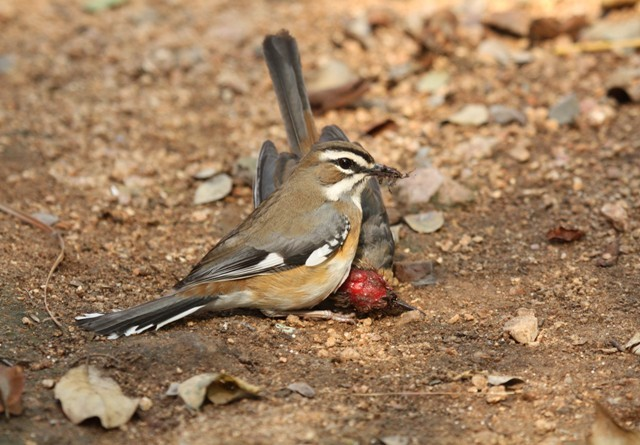
As I moved closer I noticed that the birds were both bearded scrub-robins
(Cercotrichas quadrivirgata), which are monogamous and are known to be
territorial throughout the year. By definition, a territory will be defended against
members of the same species, with the extent of the territoriality depending on
factors such as the availability of food, population densities and habitat.
Although there is no sexual dimorphism in this species, based on their behaviour,
I concluded that this was a territorial battle between two males. I expected that
at worst, the territorial male would have engaged the other male, shown him
who is boss in the area being defended, and left him to lick his wounds in
someone else’s territory. After all, these territorial disputes put both parties at
risk as the aggressor also faces a risk of being injured during the course of the
altercation, so it is in both parties’ interest to settle the dispute with as little
physical interaction as possible. The dominant bearded scrub-robin in this
territory, however, obviously had a different idea.

Early on in the battle, one bird clearly dominating the other

I’m not sure how long the fight had been going on for when I arrived, but at that
stage, although one of the birds was clearly dominating, both were putting up a
fight and, amidst a lot of wing flapping, they were rolling around on the floor.
Both seemed to be trying to peck each other, but one of the birds had a good
grip on the other’s leg, so was able to dominate him. As time went by, I noticed
that the dominant scrub-robin was making a distinct effort to peck the other,
which by this stage almost seemed submissive, on his nape and the back of his
head. This continued for a couple of minutes, after which the other bird, clearly
having sustained some injuries, was completely submissive. My expectation was
that the dominant scrub-robin, clearly the victor, would now have left the scene
and carried on with his daily foraging. This, however, was not to be.


The birds engaged in battle, fighting for survival

By now a reasonable crowd had gathered, all with the same sense of
astonishment, to witness this epic battle. Some suggested that one of the scrub-
robins had obviously come home that morning to find the other in bed with his
partner and was now teaching him a lesson. This anthropomorphic idea seems to
be the only logical explanation for what was taking place. Just as we were
discussing this, we noticed a third bearded scrub-robin enter the fray. Our
assumption was that this was the ‘offending’ female, as she stayed on the
outskirts and watched for a couple of minutes, before hopping off to carry on
with her daily activities.
All this time, without paying any attention to either the third scrub-robin or any
of us, the dominant male continued to peck at the other bird’s head and, after a
while, had pecked out the eyes and plucked off the majority of the feathers. This
took the scene to a new level and it was now obvious that the dominant male
wouldn’t stop until the other bird was dead. At this stage there was the odd
whispered suggestion that we chase the scrub-robin away to give the other a
chance of survival, however one needs to bear in mind that we are in nature and
that this is a manifestation of the idea of the survival of the fittest. We are in a
world where there is more than enough human interference and although this
may appear cruel and gory, it likely happens all around us without us even
knowing. Being able to view this sort of interaction is a privilege and enables us
to gain an invaluable insight into the behavior of these animals. Although
sometimes tempting and I must admit, it was a thought that went through my
head early on in this battle, it is best not to interfere and let nature take its
course.

The aggressor with a good grip from which to continue his attack, having plucked most of the head feathers.

After about 45 minutes the battle continued and by this stage we were convinced
that the targeted bird was on death’s doorstep, but miraculously, every couple of
minutes he would writhe, bringing about more aggression from his attacker. His
scalp was exposed and bleeding and the attacker continued to pluck flesh from
his head. The level of aggression was so pronounced that the attacker appeared
to have blood splatter on his otherwise clean belly and chest.

The head and scalp had clearly taken a beating to expose this gory scene.


The Bearded scrub-robin’s chest, showing evidence of blood splatter after the gruesome battle

Finally, in a dramatic scene after a valiant defense, the injured bird extended its
wings, raised its tail and took its last breath. This epic battle had lasted just over
an hour.

Amazingly, the victor continued to peck away at the deceased’s head for a
couple of minutes, even though it was clearly dead. Eventually he decided he
had achieved his goal. He lifted his head, had a look around, and hopped off as
though nothing much had happened, carrying on with his foraging in the leaf
litter surrounding the scene of the battle.


 The end result of the attack. After a valiant effort, the loser finally took his last breath

This interaction caused me to look at the bearded scrub-robin with new eyes.
What had always been, to me, a pretty bird, with a cheerful whistling call, has
exposed a different side to its nature, one that rivals the most aggressive and
savage I have seen in any animal of the African bushveld.

James Crookes
Trainee Guide
Singita Game Reserve

Saturday, September 26, 2009

Lioness Teaches her Cubs to Hunt


Guest post by Jason Whitehead.


Shortly after daybreak I got a call from a fellow guide on the radio to say that he had spotted a lioness on the move with her three sub adult cubs not far from where I was enjoying the view of a White Rhino. White Rhinos are incredible animals and I could sit an watch them for days, but they are a fairly common sight on the title="Welgevonden Private Game Reserve">Welgevonden Private Game Reserve situated in the northern province of South Africa. With a quick chat to my guests, we agreed to go and see of we could find her.

Welgevonden has a policy that no vehicles are permitted off road, this is to protect the environment and the many small creatures that you could easily crush by taking your 4x4 through the middle of the bush. I think this is excellent, but sometimes it can be a little frustrating when you know where an animal is but cant get to it. Today however was to be our lucky day, we did manage to find her and her cubs, but they were moving very quickly away from us through the bush which meant that the sighting would not last long. I decided to head out and wait at a road that she was heading towards about 5 minutes drive away. When we got there, there was a small herd of Zebra and Wildebeest grazing on the plain behind us, but right in the path of where I expected the lioness to to come out.

Sure enough a few minutes later, through my binoculars I spotted her in the tree line at the edge of the open plain. She too had spotted the herbivores and by her posture was obviously hungry. So in front of us we had the lioness hidden in the trees and an open area of around 100 meters to the road which we were on and then behind us about another 50 meters to the Zebra and Wildebeest. It was winter and so she did not have that much cover, so with my guests we watched her still within the trees move round to get our Land Rover right in between her and her potential prey. Then crouched very low she very slowly headed straight towards our vehicle, with her cubs hidden directly behind her in single file. If it wasn't for the fact that I knew that she was interested in what was behind us, this could have been rather frightening as it would have looked like she was hunting us! Even so we still had to be careful as a lion in hunting mode should not be taken lightly, and made sure my guest did not offer an easier alternative to a much more powerful and fast running Zebra.

Sure enough after about half an hour they got to our vehicle and then slowly moved around it, it was a fantastic sight to see such wonderful animals so close up. Now that they were behind us she and her cubs only had the tall grass as cover, but were now only 50 meters from their quarry. Then something very interesting happened, she stopped moving and her 3 cubs came around in-front of her and continued to stalk towards their prey whilst she just lay there watching. When the three cubs got to within 40 meters of the completely oblivious herd of Zebra and Wildebeest, one of them broke cover and just got up and ran towards them. With no chance of catching the herd, the cub had totally spoilt a mornings work for the rest of the family. When it had finished half heatedly running after the somewhat alarmed but now safe herbivores, they returned to their mother, who when gave the cub who had transgressed a snarl and then a tremendous slap right across it's face.

Right beside us, we witnessed some incredible animal behavior and a lesson that I think that cub would never forget. It had been an excellent morning in the bush.

About the Author
Jason Whitehead was born and grew up in Zimbabwe. Passionate about wildlife, travel and a keen wildlife and bird photographer, he is a qualified Field Guide (safari guide) and has worked on safari lodges in South Africa. He owns and runs the Safari Holiday Guide and the Best Binoculars & Binocular Reviews websites that now keep him behind a desk most of the time, but is always looking for an excuse to get back into the bush.

Would you like to post a story on this blog. Please feel free to contact me at frantic.naturalist [you know what comes here, skipped for spam] gmail.com

Tuesday, September 22, 2009

Rain to you, Rain to me


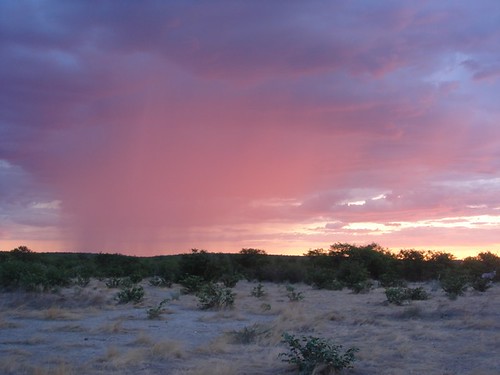
This post is simply a little chat about the weather. I got up at 3h00 this morning, partly due to chronic insomnia and but mainly due to the wonderful sound of thunder in the distance.

What do people say about rain? There are lots of feelings. An easy way to see is to have a look at Twitter:

@Plunker219 says "rain rain go away, now?"
@allyrok05 says "@charwalt im sick and tired of the rain...im outside all day at work so i need nice weather. "
@the_coffeegirl says "Really tired of the rain. But I haven't floated away yet."

But there are some voices from the opposition:
@chrisevans17 says "Awesome, it's gonna rain. That's different."

and me...
@Namibnat: We had thunder over Windhoek this morning...I really hope it's going to rain. There is a great smell of rain in the air.

Namibia is a dry country.  I grew up in northern Kenya, which is also really dry.  Even in the areas in southern and eastern Africa where there is a little more rain, usually there are long, long dry spells without any rain.

When you go for a long time without any rain, the most enjoyable, exiting rain is the rain that breaks the dry season.  Those first few short but dramatic thunder storms we get...about now.

It's still early days, and October is still considered a dry month, so I shouldn't get my hopes up to much.

When you have so little of something it conjours up memories, and rain is a good one for that.

An early memory of rain for me is from Camaroon.  My parents were there to do Africa orientation for an organization they worked for.  One thing they had to do was a survival night.  Most people had to do it alone, but if they had kids they would take one child along.  I went with my dad.  We went into the jungle as a group and had to hack our way in.  The leaders told each group where to stop and make their camp for the night.  You had a few provisions and had to make a bed.  I can't really remember much of it (I was 8) but I do remember that it rained non stop.  We tried to make a fire...the wood is drenched, the whole place is just constantly wet.

We moved to Kenya and moved to a place called Korr.  It's in the heart of the Kaisuit Desert, a rather small arid region between Marsabet and the bottom of Lake Turkana in Kenya's north.  It didn't rain much at all.  We went through the 1984 drought, which changed our lives forever, people were starving and the Kenyan government was saying that the problem was contained in Ethiopia to stop it from having any negative impact on tourism, Kenya's cash cow.

The people we lived with are the Rendile, and Rendile people love the rain in a way that I couldn't hope to explain.  The memories of the rains that break the long dry season in Kenya are amazing.  Rendile dance in a very similar way to the Masai. With braking rain, the dancing goes on all night. Wonderful. I can remember the rain on the tin roof of our house as I would go to sleep with the distant singing of the Rendiles.

When it would rain there would be lots of dry river beds that can turn into torrents of flowing water. They would come down in flash floods. It was amazing, and could at times be dangerous.

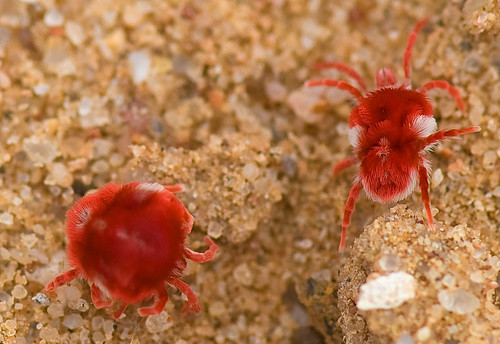
We would also get Velvet Mites coming out after the rain.  I don't know why, but the Rendille kids would run around and draw circles around them.


This Picture shows a Velvet Mite,
similar to the ones we would find as kids
Photo by Paul Garland on Flickr (licence)

Even now, after rain, we find them in the Namib.

Once we had driven to a nearby town.  The roads were basically just two tracks.  While we were there, there had been a downpour and we ended up getting stuck in the mud and sleeping there the night.  When we woke up the next morning there was a pack of wild dogs around the car.  It was such a special family experience.

Last year, on the first of April (ironic) I had a guests at Sossusvlei Desert Lodge and took them to Sossusvlei in the morning.  It rained the whole time.  A massive downpour.  If you go to Sossusvlei today, much of the green on the dunes is from that single day's rain.

In the afternoon, we were watching the weather, and when it looked like it would clear, we jumped in the game drive vehicle and headed out.  As we started, the rain started belting down.  We did about three kilometers before calling it quits.  On our way back it just kept pouring.  The rain meter showed that 19mm had fallen in those few minutes.  The roads had turned to rivers, and I could hardly drive, it was hitting my face so hard.  It was amazing.

Rain in the drier parts of Africa usually comes in thunderstorms and usually comes down hard.  The rain usually breaks the heat of summer, so the short period of being cold is a welcome relief.

At Sossusvlei Desert Lodge, where I worked for many years, when these early rains would come often the staff would simply stop work, get together and sing, just out of happyness.  It always helped prevent any guests from complain that they just left Europe to come to Africa and get away from the rain.  African Desert thunderstorms are amazing wonderful things to experience.